

Is the Ninth Circuit Really an Immigration Outlier?
Does the Sixth Circuit treat all sister-circuit immigration caselaw with similar skepticism? The short answer: No, the Ninth Circuit is an outlier.

In my last piece, When Does a Sister Circuit Persuade?, I examined how the Sixth Circuit treats Ninth Circuit authority across doctrinal areas. Immigration stood out immediately. When the Sixth Circuit cited the Ninth Circuit in immigration cases, nearly half of those citations were negative.
That raised a sharper question.
Does the Sixth Circuit treat all sister-circuit immigration caselaw with similar skepticism? The short answer: No, the Ninth Circuit is an outlier.
The dataset
Using Midpage, I searched for Sixth Circuit immigration cases from the past 10 years that explicitly referenced the “Ninth Circuit” to capture substantive discussions rather than passing string cites.
That yielded 20 cases.
I repeated the same search for every other regional circuit. Most circuits were cited by name in 14–20 Sixth Circuit immigration cases during that period. The Eighth, Tenth, and D.C. Circuits appeared less frequently, with 4–10 cases each.
To analyze the results, I added a single custom column in each of my circuit-specific Midpage notebooks:
Does this case cite the named sister circuit for a significant immigration issue?Answer only: positive, negative, neutral, or none.
After Midpage analyzed each circuit’s results,1 I exported the notebooks to Excel for data visualization.
The result
The Ninth Circuit is an outlier.
Over the past decade, when the Sixth Circuit cites another circuit by name in an immigration case, it almost always does so positively. Indeed, for every circuit other than the Ninth, the number of negative citations over the past decade was either one or zero.
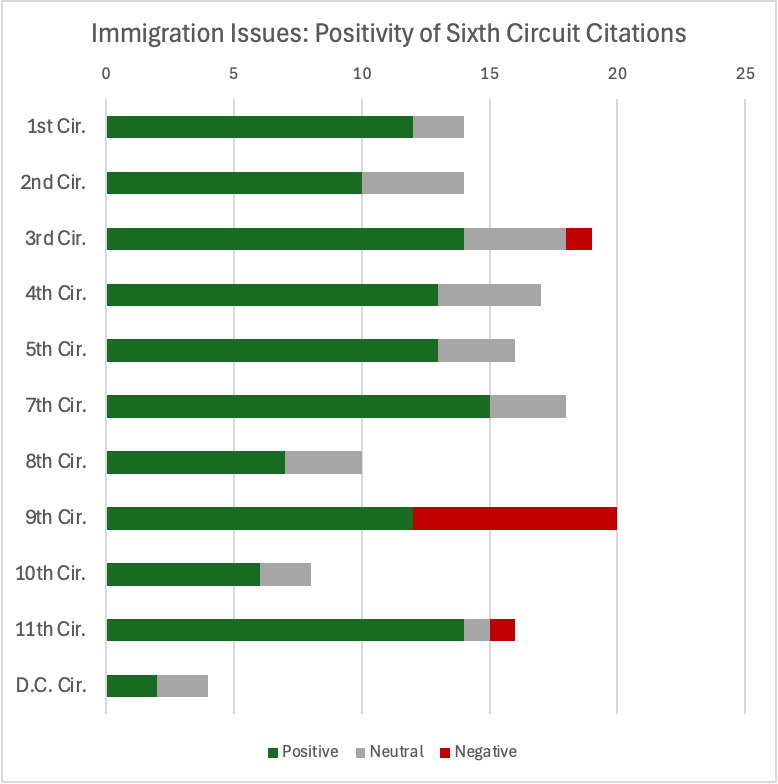
But, in sharp contrast, when the Sixth Circuit name-drops the Ninth Circuit in immigration cases, 40% of those citations are negative.
To put that in context:
Ninth Circuit: ~40% negative
Eleventh Circuit: ~6% negative
Third Circuit: ~5% negative
The eight remaining circuits: 0% negative
A practitioner’s perspective
The Ninth Circuit has long been perceived—fairly or not—as more protective in certain immigration contexts. Whether that perception is accurate, the Sixth Circuit’s citation behavior suggests it treats Ninth Circuit immigration law as something to be distinguished from, rather than built upon, far more often than any other circuit’s immigration jurisprudence.
I shared these results with Professor Emily Brown, Director of the Immigration Clinic at The Ohio State University Moritz College of Law, and she explained that immigration lawyers often cite immigrant-friendly Ninth Circuit cases cautiously:
“We tend to cite immigrant-friendly cases from the Ninth Circuit only when we can’t find other persuasive authority for a different circuit, because we understand that the Ninth Circuit is viewed the way you suggest.”
Cross-circuit citation is strategic. If certain circuits are predictably treated differently in particular doctrinal areas, that is something lawyers should know.
Tools like Midpage now make it possible to detect those patterns in minutes, not months.
Want to run your own cross-circuit check?
If you want to quickly aggregate and intelligently analyze caselaw data for your own empirical projects—across circuits, topics, or time windows—Midpage makes it simple to build, tag, and export a dataset like this. Head over to Midpage for a two-week free trial.
A note on methodology.
This analysis was generated using AI-assisted case review within Midpage. The tool categorized citation behavior based on structured prompts and custom columns.
While such analyses are increasingly accurate, I have not independently reviewed each case. The purpose here is not a fully-audited empirical study. It is to demonstrate how quickly lawyers can test cross-circuit hypotheses using modern research tools.
As a sense check, I shared my findings with Professor Brown. They resonated.
 |
|