

When Does a Sister Circuit Persuade?
Patterns across doctrinal areas in how the Sixth Circuit treats Ninth Circuit authority.

When Does a Sister Circuit Persuade?
I was working on a pro bono immigration matter when the supervising attorney gave me a curious piece of advice: don’t bother citing that sister circuit—our circuit won’t give it any persuasive weight.

That struck me as odd. One of the animating premises of our federal courts system is uniformity in federal law. If courts routinely discount sister-circuit authority, especially in predictable doctrinal pockets, that is worth understanding.
So I ran a small-scale empirical check on how my home circuit in the Midwest cites its West Coast counterpart, asking: Are there patterns across doctrinal areas in how the Sixth Circuit treats Ninth Circuit authority?
The dataset
To keep the project organized and replicable, I used Midpage:
Search: Sixth Circuit cases that mention “Ninth Circuit” (not just “9th Cir.”), which is more likely to capture a substantive discussion rather than a passing string cite.
Time window: the past five years, to keep the dataset manageable.
Yield: 187 cases.
The coding approach
Within Midpage, I added three custom columns:
Most significant issue for which the Sixth Circuit cited the Ninth Circuit.
Positivity of the citation: whether the Sixth Circuit’s use of the Ninth Circuit authority was positive, negative, or neutral.
Doctrinal category: I mapped each issue to a set of 15 broad doctrinal buckets, so I could look for patterns across doctrines, rather than individual cases.
After Midpage analyzed all 187 cases across my three custom columns, I exported the results to Excel for basic analysis and visualization.
What jumped out
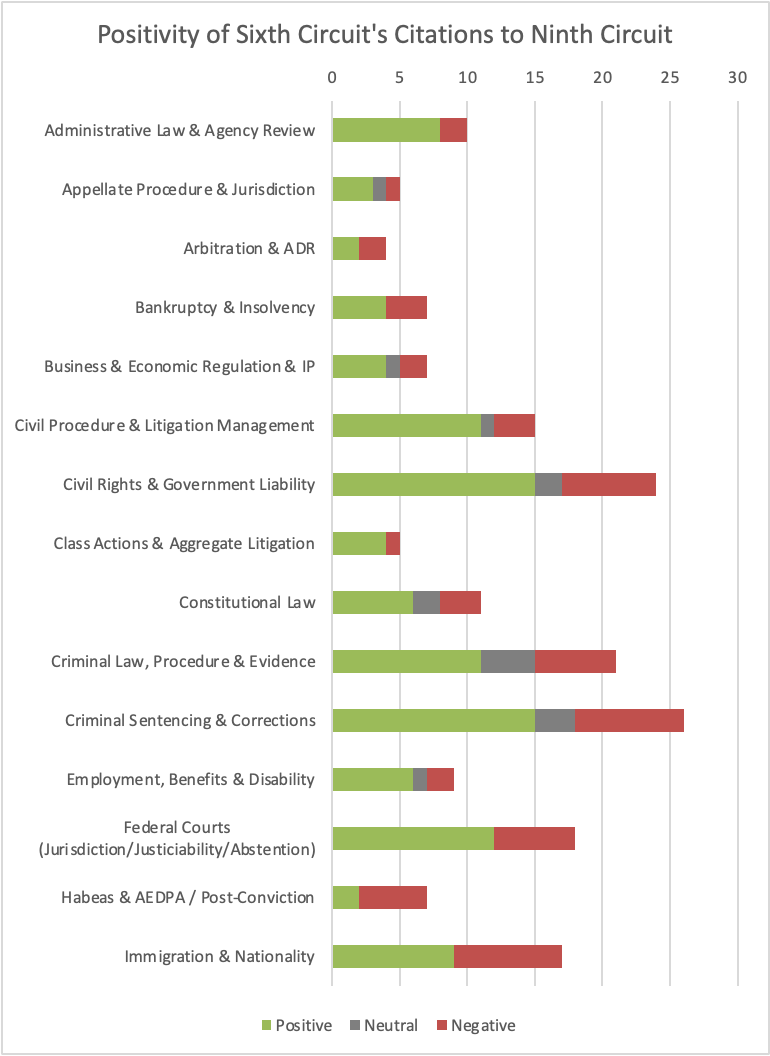
When the Sixth Circuit name-drops the Ninth Circuit, 60% of those citations are positive, 33% are negative. Sentencing issues and civil-rights cases led the pack for the most citations, and these high-volume litigation areas tracked the overall results, having twice as many positive citations as negative. But some doctrinal areas revealed more polarized results.
1) Two categories look unusually “friendly”
When the Sixth Circuit cited the Ninth Circuit in these buckets, it was most likely to do so positively:
Administrative Law & Agency Review: 80% positive (8 of 10)
Class Actions & Aggregate Litigation: 80% positive (4 of 5)
Small sample sizes might skew results here, but the contrast with the “contentious” buckets below is still notable.
2) One category is an outlier in the other direction: habeas
The most striking pattern is how frequently the Sixth Circuit cites the Ninth Circuit negatively in habeas:
Habeas & AEDPA / Post-Conviction: 71% negative (5 of 7)
That is a high negative rate in any cross-circuit comparison, and it’s even more striking because habeas doctrine is already bounded by the myriad constraints of AEDPA.
3) Arbitration and immigration are the next most contentious
Two more buckets show elevated negative rates:
Arbitration & ADR: 50% negative (2 of 4)
Immigration & Nationality: 47% negative (8 of 17)
Immigration is especially interesting because it is also among the highest-volume categories in this dataset. In other words: the Sixth Circuit cites the Ninth Circuit fairly often in immigration cases—but nearly half the time it does so in a negative way.
Why this matters
Lawyers cite sister-circuit authority all the time—sometimes because the home circuit is silent, sometimes to frame a split, sometimes to persuade.
But if certain doctrinal areas predictably generate cross-circuit friction, that should affect how you brief. A Ninth Circuit cite may be an asset for some issues but, for others, a last resort.
Want to run your own cross-circuit check?
If you want to quickly aggregate and intelligently analyze caselaw data for your own empirical projects—across circuits, topics, or time windows—Midpage makes it simple to build, tag, and export a dataset like this. Head over to Midpage for a two-week free trial.
 |
|