

When NIL Deals Require Players to “Stay-or-Pay”
Mapping the transfer portal–roster stability fight to existing legal analogues using Midpage.

To distract myself from the College Football Playoff loss of my beloved Buckeyes, I’ve been channeling my feverish football fandom into a more productive outlet: what happens when NIL deals collide with the transfer portal.
My initial interest was sparked by a Seyfarth Shaw write-up on UGAA v. Wilson. The case is a useful illustration of the compliance and litigation problems that arise when schools experiment with roster-stability mechanisms that make transferring expensive and when they become intertwined with the assignment and enforcement of NIL rights. The case tees up a question that’s going to recur as NIL and revenue-sharing structures evolve: if a university-side agreement requires a transferring athlete to pay the university, how will courts analyze it?
There is not yet a clean body of precedent squarely addressing NIL clawbacks tied to transfer behavior. So I took the next-best approach: map adjacent doctrine that courts already use to evaluate money-backed retention devices—especially (1) liquidated damages constraints (reasonable forecast versus penalty) and (2) antitrust doctrine treating restrictions on mobility as restraints in a labor market.
My Midpage workflow: building a mobility-restraint case law map
Rather than hunt for a perfect NIL analogue that probably does not exist, I asked Midpage to retrieve cases at the intersection of repayment obligations, forfeiture provisions, restraints on worker mobility, and antitrust framing under the Sherman Act.
I then asked Midpage to help me develop a Boolean query designed to catch cases tying together liquidated-damages-type provisions and mobility restraints. Based on this instruction and all the cases it had retrieved from my initial query, Midpage gave me this query:
(
  ("liquidated damages" OR clawback OR "repayment obligation" OR "forfeiture provision")
  AND
  ("employment agreement" OR "employment contract"
   OR noncompete OR "non-compete"
   OR "no poach" OR "no-poach"
   OR "no hire" OR "no-hire"
   OR "no rehire" OR "no-rehire"
   OR "non solicitation" OR "non-solicitation")
  AND
  (antitrust OR "Sherman Act" OR "restraint of trade")
  AND
  ("labor market" OR "input market" OR "employment market"
   OR "employee mobility" OR "worker mobility" OR monopsony)
)
I ran that search using Midpage’s Manual Search mode, which yielded 22 cases.
I added them to my Midpage notebook and created columns that answer litigation questions: posture, outcome, favorability, and factual similarity. Multi-column filtering made it easy to identify which favorable cases were closest to my hypothetical fact pattern and to surface the unfavorable cases I’d need to distinguish.
Finally, I exported the notebook to CSV and created a public site so I could share it and let readers explore it without needing a Midpage account. Take a look here.
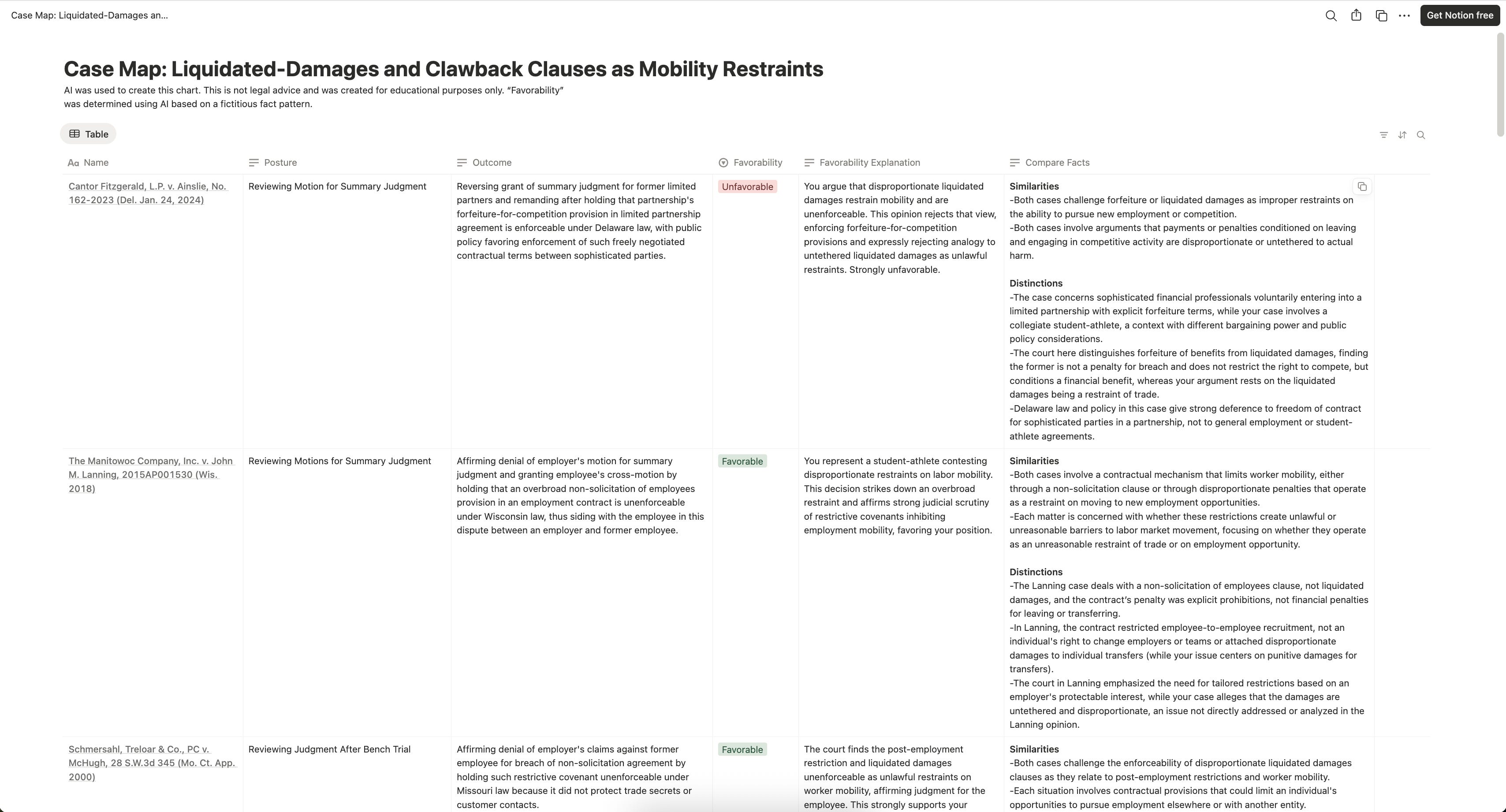
If you want to test out making your own table in Midpage, where you can add bespoke analysis columns tied to your evolving case theory and click on source-linked support for each cell, head over to Midpage for a 2-week free trial.
 |
|